

Shortlist Compact CNNs for Nighttime Tower Detection
Start with compact single-stage detectors, then select on measured nighttime performance and capture-to-alert latency. Compact YOLOv5 and YOLOv8 variants deserve early testing on remote forestry hardware. Pruning and convolutional block attention module (CBAM) modifications belong alongside an unchanged baseline. Neither modification establishes an advantage until genuine nighttime recordings show fewer missed ignitions or a useful reduction in resource demand.
A deeper backbone can consume the compute margin needed for image acquisition, preprocessing, communications, and alert delivery. Yet parameter count alone cannot establish which network will perform better. A Faster R-CNN baseline may justify its cost on a particular camera and terrain. A daytime-trained RGB detector may struggle because its learned smoke features no longer match the nighttime sensor domain, regardless of network depth.
Build a Comparable Nighttime Trial
- Fix the observation task. Label visible flame, exposed thermal anomalies, and visible smoke separately. Define which observation should initiate an emergency response alert.
- Hold the inputs constant. Compare models using the same spectral channels, image dimensions, training partitions, and alert policy.
- Measure the complete path. Record missed ignitions, capture-to-alert latency, operator-reviewed false alerts per camera-night, peak device memory, and energy per camera-night.
A proposed applied-lab evaluation should combine multispectral bench sequences with original mountaintop camera recordings. Bench inputs allow controlled nuisance checks; tower recordings expose changing terrain contrast, camera movement, and communications delays. For a historical assessment, request paired recordings from 2023–2025 with ignition timestamps, camera settings, detector outputs, and operator adjudications. That window describes an archive request, not an examined dataset.
The resulting ranking applies to the tested camera, terrain, spectral bands, and edge device. Satellite detection results cannot establish that ranking for tower-mounted AI detection systems.
Separate Nighttime Smoke Contrast From Thermal Emission
Darkness removes solar illumination that makes daytime smoke conspicuous. Passive near-infrared (NIR) imaging still needs available illumination. Short-wave infrared (SWIR) can capture emission from sufficiently hot material. Long-wave infrared (LWIR) cameras measure thermal radiance from the target and its surroundings, including warm objects unrelated to fire.
Common band conventions place NIR around 0.75–1.4 micrometers and SWIR around 1.4–3 micrometers; many uncooled LWIR cameras operate approximately within 8–14 micrometers. Record the instrument’s actual response. These conventions do not describe every camera.
Label the Mechanism Behind Each Bright Patch
A bright detection near a logging road needs a different review from a stationary thermal patch on exposed rock. Headlights and moonlit clouds primarily confuse low-light optical channels. Exhaust stacks and residual rock heat create thermal confounders. Grouping all of them as “nighttime glare” removes the distinctions needed to diagnose feature-map errors.
When a bright patch appears to persist across frames, a controlled check should hold preprocessing constant and compare its spectral channel, exposure state, motion, and background location. A proposed nuisance review can retain 30–120-second sequences around each trigger. That check can separate moving headlights from a persistent industrial source without treating brightness itself as evidence of ignition.
- Keep exposure and gain metadata with each candidate detection.
- Annotate known background objects separately from uncertain fire signatures.
- Review persistence and motion across sequences rather than isolated frames.
Darkened RGB Stops Here
CycleGAN-darkened daytime images provide optical appearance augmentation. They do not supply calibrated LWIR radiance, emissivity, detector noise, or nighttime thermal contrast. Keep those images out of any category described as measured thermal training data.
Sensor glow also requires channel-specific inspection before it becomes a training label. If a candidate changes with the camera’s exposure or correction state, what evidence remains that the scene itself changed?
Compare YOLO, Faster R-CNN, and Plume Segmentation Separately
Split recordings by camera site and incident before extracting frames. Adjacent views of one fire must not enter both training and testing. Otherwise, apparent generalization may reflect repeated terrain, smoke shapes, or camera characteristics.
YOLOv5 and YOLOv8 use single-stage detection. Faster R-CNN generates region proposals before region-level classification and box refinement. These structures motivate latency testing, but they do not establish a numerical speed ranking on an unspecified embedded GPU. CBAM adds channel and spatial attention; its contribution requires an otherwise matched comparison.
| Candidate | Embedded Latency | Small Thermal Targets | Artificial-Light Clutter | Memory Footprint |
|---|---|---|---|---|
| Compact YOLOv5/v8 | Measure capture-to-output latency. | Group detection results by target pixel area. | Test optical and thermal nuisances separately. | Measure peak device memory. |
| Pruned or CBAM-modified YOLO | Compare against the unchanged baseline. | Check whether faint targets survive modification. | Measure changes in nuisance-triggered alerts. | Measure pruning savings or attention overhead. |
| Faster R-CNN with ResNet/FPN | Include proposal and refinement execution. | Use the same box annotations and pixel-area groups. | Apply the same alert policy. | Measure peak memory under sustained inference. |
| U-Net / DeepLabV3+ | Time mask generation separately. | Evaluate plume masks, not interchangeable hotspot boxes. | Review nuisance regions in predicted masks. | Measure at the intended mask resolution. |
Record median and 95th-percentile latency in milliseconds and peak memory in MiB. Keep input dimensions, batch size, precision, confidence threshold, and runtime configuration fixed for paired architecture checks. A proposed 30–60-minute continuous run can expose thermal throttling and sustained-power behavior that a short burst misses.
Keep Plume Shape Separate From Ignition Location
U-Net and DeepLabV3+ produce segmentation masks. Under available moonlight or amplified low-light imaging, those masks can support smoke-boundary analysis, but plume-mask overlap and time-to-first-fire-alert remain separate outcomes. A detailed mask cannot compensate for a late ignition alert.
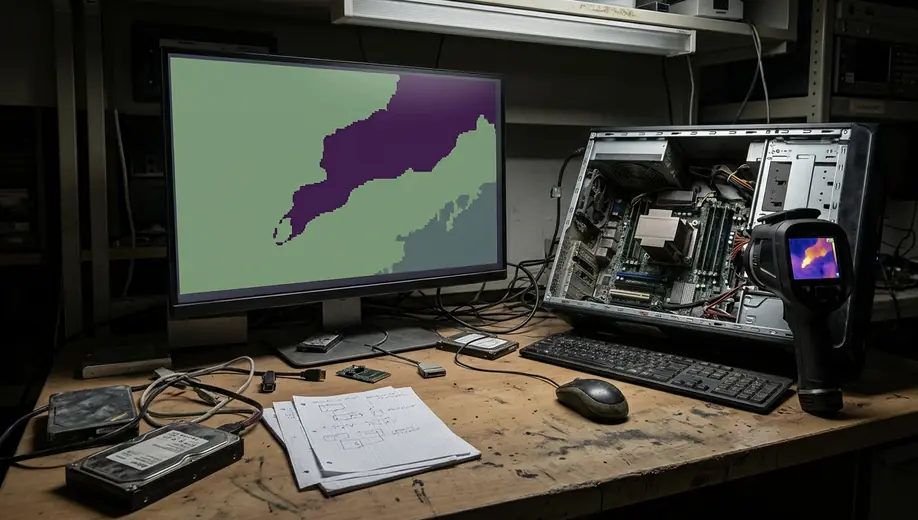
Cooling-plume box drift describes a detector’s bounding box migrating as smoke contrast fades while the independently annotated ignition location remains stationary. Track centroid displacement against that reference and fixed landmarks across 10–30-second clips. Camera movement requires its own accounting.
A conventional camera cannot localize a hotspot behind opaque canopy. Preserve the distinction between a visible smoke cue and a directly observed thermal source when reporting localization performance.
Fuse Low-Light and LWIR Features Without Losing Thermal-Only Ignitions
Establish separate low-light and thermal baselines before adding fusion. Early fusion stacks registered channels before feature extraction. Intermediate-feature fusion retains modality-specific encoders and combines their representations later. The latter preserves separate processing paths but adds implementation and resource costs that the edge benchmark must capture.
A low-lux RGB camera, an NIR-sensitive camera, and an uncooled LWIR microbolometer measure different scene properties. Preserve their exposure metadata and normalization pipelines. Treating the streams as interchangeable grayscale inputs hides differences that fusion must handle.
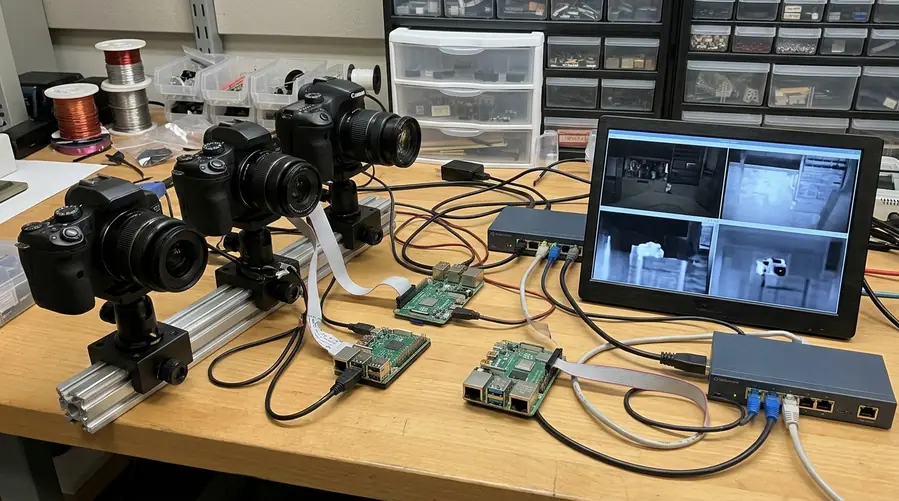
The NIR Confirmation Boundary
Cross-modality attention can strengthen a fire hypothesis when an LWIR heat cluster aligns with evolving optical texture. That relationship stops being reliable as a mandatory confirmation rule. Requiring upward-moving NIR smoke would exclude thermal-only ignitions and plumes that wind displaces laterally.
Evaluate the fused model on those cases explicitly. A thermal-only detection path should remain available under the tested alert policy rather than disappearing behind an optical-confirmation gate.
Registration Costs Follow PTZ Movement
Dual-lens parallax, lens distortion, and changing pan-tilt-zoom settings limit pixel alignment. Calibrate relative sensor pose at the intended presets and report residual alignment error in network-input pixels. A proposed calibration sequence should retain 10–20 seconds at each selected preset and repeat after commanded movement. Inspect pairs during camera shake as well as stationary operation.
Timing introduces a separate limit. A hypothetical 30-frame-per-second optical stream has approximately 33 milliseconds between frames; a 9-frame-per-second thermal stream has approximately 111 milliseconds. Match capture timestamps rather than frame indices, and retain exposure timing. Network arrival timestamps alone cannot establish simultaneous observations.
Better registration costs calibration effort and maintenance time. Which fusion improvement survives when the camera moves under wind rather than remaining fixed on the bench?
Select the Edge Model Against Power and Dispatch Costs
Forestry camera networks need a model that fits the whole station’s operating envelope. Benchmark FP16 first, then calibrate INT8 with representative nighttime thermal scenes. Runtime support and operator execution determine whether lower precision actually reduces latency, memory demand, or power.
- Challenge quantization with faint targets. Include weak hotspots, bright industrial sources, changing thermal backgrounds, and sensor correction events. Compare missed targets and detection scores under the same alert policy.
- Measure station energy. For a proposed power assessment, log 7–14 consecutive nights. Include cameras, communications, heaters, and PTZ activity; calculate watt-hours from measured power and operating duration before sizing battery reserve and solar recharge.
- Count dispatch-facing errors. Report operator-reviewed false alerts per camera-night alongside ignition detection delay. Frame-level accuracy can conceal repeated alarms from one exhaust stack.
Count the Entire Alert
A fast inference result leaves acquisition, preprocessing, transmission, and alert handling unfinished. Use capture-to-alert latency for deployment selection and capture-to-output latency for diagnosing the model pipeline.
Discussion
No comments yet.